



Introduction
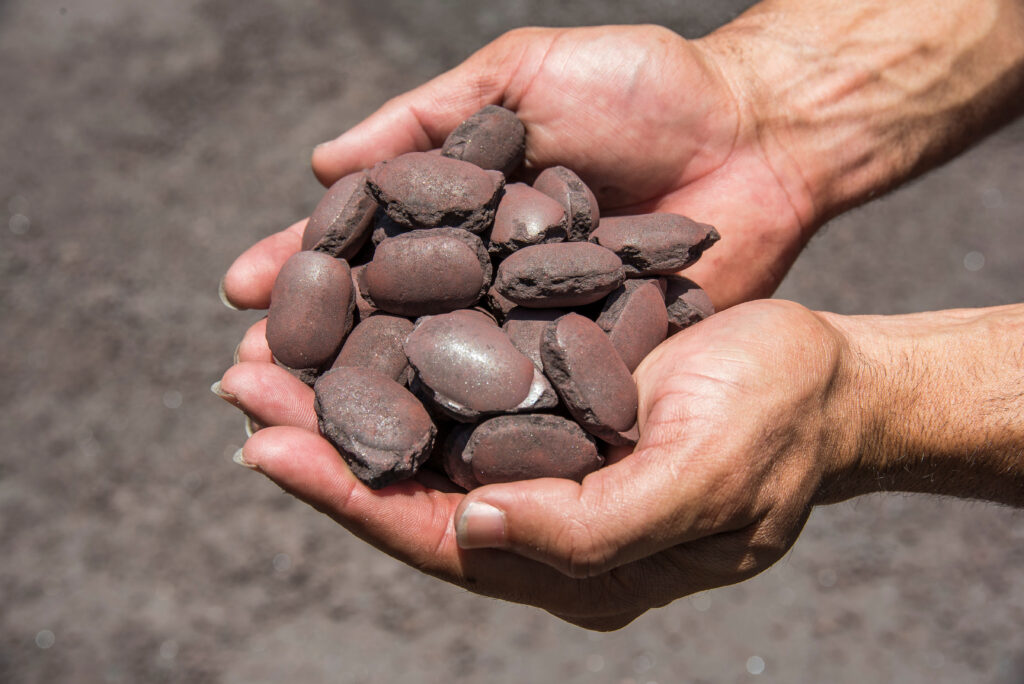
Cold-agglomerated briquettes (CBQ) made from iron ore fines are being developed as a promising new feed material for ironmaking. Their main advantage is the potential to lower carbon emissions by reducing the need for traditional heat-intensive agglomeration processes such as sintering. While pelletizing itself is not heat intensive, the combined processes of grinding and pelletizing are energy intensive due to their significant electrical power requirements. Laboratory studies and commercial-scale trials have shown that CBQ can achieve the physical, chemical and metallurgical properties needed for effective use in direct reduction (DR) shaft furnaces, and they have also been successfully used in blast furnaces (BFs).
In a DR shaft furnace, reduced iron can be discharged either hot or cold. When discharged hot, it can be sent directly to an Electric Arc Furnace (EAF) or compacted into hot briquetted iron (HBI), which offers better resistance to reoxidation during storage and transport. Because HBI quality depends on the characteristics of the DRI feedstock, it is important to confirm that DRI produced from CBQ can be converted into HBI that meets industrial standards.
This article highlights hot-briquetting trials conducted at the Midrex Research & Development Technology Center using DRI produced from oxide pellets, CBQ, and blends of the two. The resulting HBI was evaluated for chemical composition, physical strength, and weathering resistance to determine whether CBQ-based HBI can match the performance of conventional pellet-based HBI and satisfy industrial requirements.
Objectives & Physical Properties
To evaluate the suitability of cold agglomerated briquettes (CBQ) as a feedstock for producing high-quality hot briquetted iron (HBI), this study focuses on comparing the performance of CBQ-derived HBI with conventional pellet-based HBI across chemical, physical and weathering characteristics under industrially relevant conditions. It should be noted that the present work does not examine the suitability of CBQ for use in direct reduction (DR) shaft furnaces, as this aspect is addressed separately in other studies. The study adopts the following objectives:
- Evaluate the feasibility of CBQ as a DR feedstock by determining whether DRI produced from cold agglomerated briquettes can be successfully converted into HBI.
- Compare CBQ-based HBI with conventional pellet-based HBI in terms of chemical composition, physical characteristics such as density and strength, and overall quality.
- Assess the effect of blending ratios (CBQ and pellets) on HBI performance.
- Verify compliance with industrial specifications for HBI, including density and mechanical strength.
- Determine weathering resistance of CBQ-based HBI and compare its reoxidation behavior with pellet-based HBI during outdoor storage-like conditions.
- Confirm the potential of CBQ to support lower-carbon ironmaking while maintaining or improving product performance.
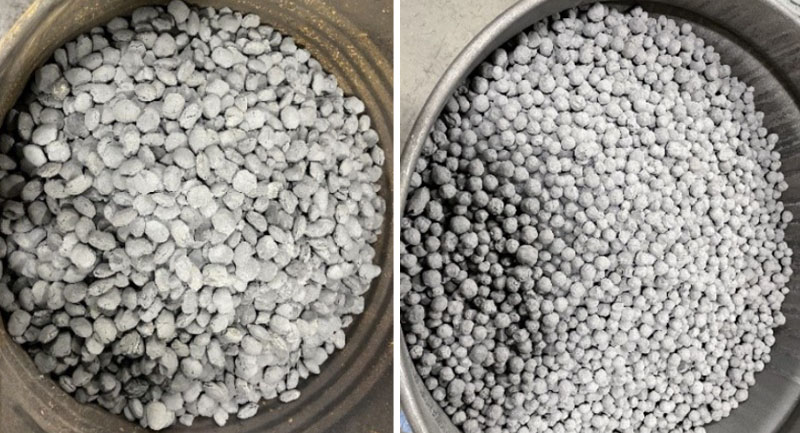
The chemical compositions of the CBQ and oxide pellets used in this study are shown in Table 1, while their physical properties are summarized in Table 2. Both materials were produced from similar iron oxide sources. This ensured a consistent starting point for evaluating how feedstock type influences DRI and HBI performance.


DRI Preparation For HBI Trials
Using the Large Reduction Furnace (LRF) at the Midrex Research & Development Technology Center, CBQ and oxide pellets were reduced in a fixed bed within an externally heated retort. The oxide feedstocks were reduced using a syngas mixture of H2, CO, CO2, H2O, CH4, and N2, designed to mimic natural gas–based reduction conditions in a MIDREX® Reduction Furnace. While the LRF does not replicate the exact conditions of a direct reduction (DR) shaft furnace, it is designed and operated to produce direct reduced iron (DRI) with properties representative of material produced in a commercial shaft furnace, enabling meaningful comparative evaluation of different feedstocks.
The LRF operating temperature was maintained between 700 and 850 °C, which is similar to the reduction zone temperature of a MIDREX reduction furnace. Temperature adjustments were made as needed based on the characteristics of each oxide feedstock. After reaching the target metallization level, the reduced material was cooled under a nitrogen atmosphere to prevent reoxidation. In this work, the DRI was not carburized to reduce the number of test variables. The material was then discharged and screened to remove -3 mm fines.
Three LRF batches were used to produce the CBQ DRI sample, and two batches were used for the pellet DRI sample. After blending these LRF batches, the composite samples for CBQ-DRI and pellet-DRI were prepared. Chemical analyses, including metallic iron and carbon content, were performed on these composite CBQ-DRI and pellet-DRI samples.
Using the composite DRI samples, four DRI blends (approximately 250 kg each) with various mixing ratios were prepared for the briquetting trials:
- 100% CBQ DRI
- 50% CBQ DRI / 50% pellet DRI
- 30% CBQ DRI / 70% pellet DRI
- 100% pellet DRI
Hot Briquetting
With the four DRI blends prepared, the research team turned to the hot briquetting process. Each DRI blend was preheated to above 750 °C under inert atmosphere in the LRF and then transferred to a commercial-scale hot briquetting (HB) machine (Figure 2). The material was fed into the briquetting rolls using a screw feeder. The resulting HBI pieces measured approximately 48 mm × 134 mm × 32 mm and weighed about 800g each. Each batch required approximately two minutes of operation.
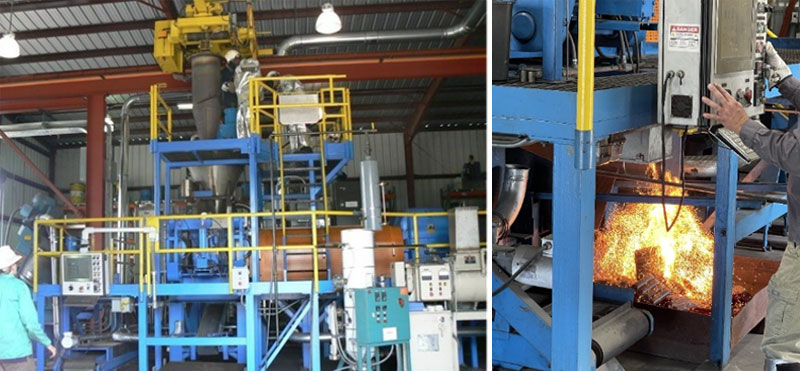
The operating parameters of the HB machine were identical for each trial. After briquetting, the HBI samples were air cooled and collected for chemical analysis (metallization and carbon content) and physical testing, including density, tumble strength and drop strength.
Weatherability Evaluation
A weatherability test was conducted to assess the relative weathering resistance of the HBI samples. The test compared weight changes during an eight week outdoor exposure period. Five HBI pieces from each batch were placed on an outdoor table under identical environmental conditions (Figure 3).
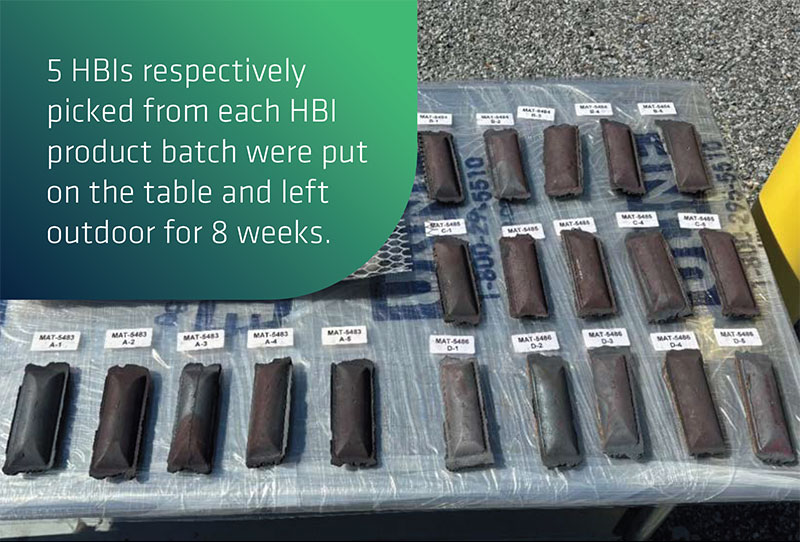
Every two weeks, the samples were collected and dried in an oven at 120 °C under a nitrogen atmosphere. After drying, the samples were weighed to measure any weight gain or loss. The samples were then returned to the test stands to continue the test.
At the end of the eight week period, chemical analyses for metallic iron and carbon content were performed on each HBI sample. These results were used to support the weatherability assessment based on the measured weight changes.
Results
Chemical Analysis
The composite chemical analyses of CBQ-DRI and pellet-DRI, presented in Table 3, indicate that both materials achieved consistently high metallization and low carbon levels. The DRI feedstock was intentionally produced at a higher metallization and lower carbon levels than is typically achieved in commercial operating plants to ensure uniform metallization and carbon across all test materials. This approach eliminated metallization and carbon as an experimental variable, allowing the effects of other factors on HBI quality to be evaluated independently.
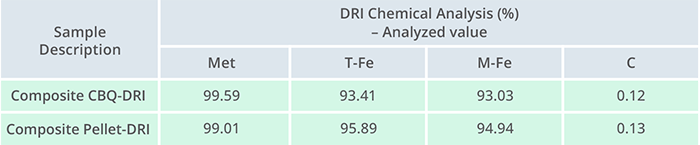
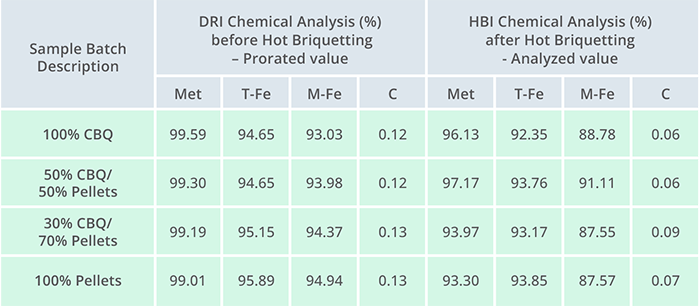
As anticipated, CBQ-DRI exhibited slightly lower total iron content due to its inherently lower iron concentration, while pellet-DRI showed marginally higher metallic iron content. The chemical compositions of the four DRI sample batches with the various mixing ratios were calculated on a prorated basis using the composite CBQ-DRI and pellet-DRI analyses. Chemical analyses were also performed on the HBI products generated from these four DRI batches. Table 4 presents the metallization (%), total Fe (%), metallic Fe (%), and carbon (%) for both the corresponding DRI feed and resulting HBI product for each batch. Overall, the DRI batches maintained uniformly high metallization levels above 99%, whereas the HBI samples displayed greater variability but remained within acceptable metallization levels above 93% across varying CBQ mixing ratios. The carbon contents of the DRI samples were maintained low, to achieve the consistently homogeneous carbon level for all sample batches.
Physical Analysis
Apparent Density
The apparent density results (the average of five HBI samples for each batch) show a clear trend with respect to CBQ content. As the proportion of CBQ in the feed increased, the average density of the HBI also increased. At the same time, the variation between samples decreased, indicating more consistent product quality (Figure 4).
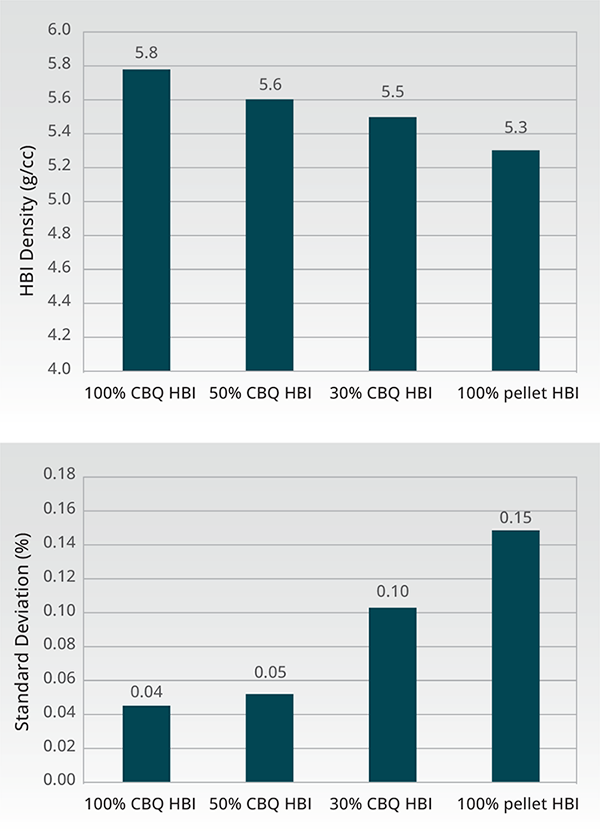
This suggests that CBQ-based DRI compacts more effectively during briquetting, resulting in denser and more uniform HBI. Larger CBQ seems to help achieve better compaction when the operation condition of the feeder maintains the same. Higher density is an important property, as it is typically associated with improved handling characteristics such as higher mechanical strength and lower reactivity during storage and transport.
Tumble and Drop Strength
The mechanical strength of the HBI samples was evaluated using tumble and drop tests. Tumble tests were conducted with ISO 15967:2007. Drop tests were also conducted with Midrex standard procedure (4 drops from a height of 5m).
Tumble Index was consistently above 95%, and Abrasion Index was low for all samples.
Shatter Index results were also favorable. The HBI produced from 100% CBQ and the 50/50 blend showed performance comparable to the pellet-based HBI. The 30% CBQ blend showed a slightly lower drop strength, although the reason for this difference is not known. Despite this, all samples demonstrated sufficient mechanical durability for industrial use (Table 5).

Overall, the results confirm that incorporating CBQ into the feed does not negatively affect the mechanical strength of the final HBI product.
Weatherability Performance
The weatherability test showed differences in performance depending on the CBQ content. Over the eight-week exposure period, all samples experienced some weight gain, indicating reoxidation of metallic iron. The extent of weight gain was lower (on average) for samples with higher CBQ content: The 100% CBQ HBI showed the smallest average increase in weight, while the 100% pellet HBI showed the largest. However, most results are within one standard deviation. The variation between individual samples of each composition (as shown by the standard deviation bars in Figure 5) is decreasing with increasing CBQ content, indicating a more consistent product.
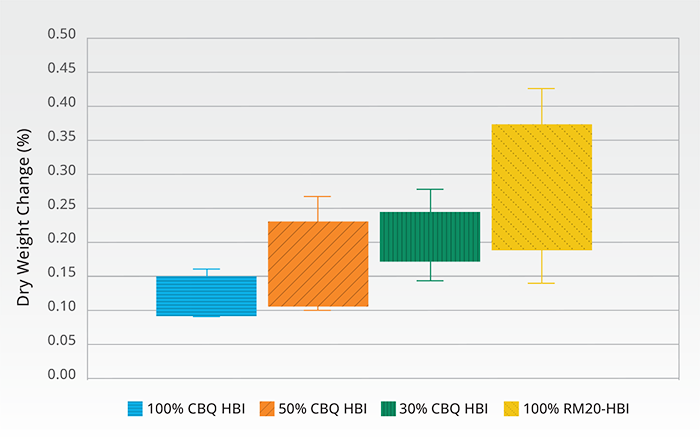
The measured reductions in metallization after exposure followed the same trend as the weight changes, confirming that the weight gain was primarily due to reoxidation. The improved weathering resistance observed with increasing CBQ content is primarily attributed to the higher density of the resulting HBI. As CBQ content increased, briquette density increased, reducing porosity and limiting the ingress of oxygen and moisture. The relationship is consistent with previous Midrex weatherability test results which have shown that higher and more uniform HBI density is associated with improved weathering resistance.
The improved weatherability performance indicates that HBI made with CBQ will have similar or better stability during storage and transport, resulting in lower yield losses from oxidation.
Conclusion
This study provides clear evidence that producing high-quality HBI from cold agglomerated briquettes (CBQ) is feasible, and that CBQ can serve as a viable alternative to conventional oxide pellets without compromising product performance. The testing and accompanying results of this study ultimately demonstrate that CBQ is a viable DR feedstock, through:
- Consistent briquetting quality across different blend ratios of CBQ
- Apparent density exceeding 5.0 g/cm³, meeting DRI(A) transport requirements; CBQ-based material achieved higher density than industrial DRP benchmarks, with the trend expected to persist at industrial scale.
- Mechanical strength (tumble, abrasion, and drop resistance) is comparable to pellet-based HBI
- Improved weathering performance compared to pellet-based HBI, resulting in lower metallization losses due to reoxidation during storage and transport.
The results show that increasing CBQ content can improve both density and weathering resistance, without negatively affecting mechanical strength. This suggests that CBQ-based HBI may offer operational and quality benefits beyond simple equivalency to pellets. CBQ represents a promising development in DR feedstock technology, particularly as the industry continues to focus on reducing carbon emissions.
References
- F. C. Dutra, V. G. de Resende, F. V. Parreira. Production process of iron ore fines agglomerate and agglomerated product. BR102019023195B1, 2019, Brazil.
- V. Chevrier. (2018, September) Results of lab trials of MIDREX ACT™. https://www.midrex.com/tech-article/results-of-lab-trials-of-midrex-act/
- V. G. de Resende, F. C. Dutra, F. V. Parreira, F. V. Pimenta. Process for producing iron ore agglomerate for use in direct reduction reactors, and agglomerate product. BR102023025626-0, 2023, Brazil.