

Improving Operations, Safety, and Compliance in DRI Plants
Introduction
The reformer is the thermal heart of a MIDREX® Plant. Multiple burners fire continuously to sustain the high temperatures required to reform natural gas and recycled process gases into the reducing atmosphere that converts iron oxide to metallic iron. In a process defined by continuous operation and tight energy budgets, burner performance has always mattered. What has changed is the external environment in which that performance is evaluated.
Emissions regulations for NOx are tightening across all major steelmaking regions. At the same time, various economic incentives to reduce NOx have been embedded in environmental policies worldwide. Meanwhile, the transition from the previous EN 746:2010 to ISO 13577:2023 has materially raised the baseline for burner control system design and compliance.
For operators of existing MIDREX Plants, what may begin as a compliance question also presents an operational opportunity. Low NOx burners and modern burner control systems offer improvements in energy efficiency, combustion stability, and plant safety. This article explains the underlying chemistry of NOx formation, the technologies used to reduce it, and the key considerations in evaluating burner upgrades for operating DRI plants.
What Is NOx And Why Does It Matter?
Nitrogen oxides (NOx) are a group of gases produced during high-temperature combustion. The two primary species of concern are nitric oxide (NO) and nitrogen dioxide (NO2), although other oxides, including nitrous oxide (N2O), may be present in smaller quantities. NOx is a significant constituent of photochemical smog and is harmful to human health, causing respiratory conditions such as asthma. It also contributes to the formation of ground-level ozone and fine particulate matter (PM2.5) and is implicated in acid rain and reduced visibility. Nitrous oxide is also a potent greenhouse gas with ozone-depleting properties.
In combustion systems, NOx is generated through three principal mechanisms:
- Thermal NOx is the dominant pathway in high-temperature applications. It arises when molecular nitrogen in the combustion air or furnace atmosphereis oxidized at flame temperatures above 1,525 °C (2,780 °F) as described by the Zel’dovich mechanism.
- Fuel-bound NOx arises when the fuel itself contains nitrogen, as is the case with coal or heavy fuel oils. This pathway is generally not a concern when firing commercially available natural gas or propane.
- Prompt NOx forms when hydrocarbon radicals in fuel-rich flame regions react with atmospheric nitrogen in the earliest stages of combustion. It contributes less than thermal NOx to overall levels in high-temperature processes but becomes more significant in the fuel-rich zones characteristic of staged-combustion burner designs.
In MIDREX Plants, thermal NOx is the mechanism of primary concern. The reformer operates at high temperatures and continuously burns significant volumes of fuel gas. Both the burner design and the control of combustion conditions (peak flame temperature and the flame’s chemical environment) are therefore important levers for managing NOx output.
Low NOx Burner Design
Burner designs that lower flame temperature or reduce oxygen availability at the hottest part of the flame can substantially reduce NOx output by disrupting the thermodynamic conditions that favor thermal NOx production— without sacrificing heat output or flame stability. Several strategies are used to achieve this, often in combination:
- Premixing homogenizes fuel and air distribution before ignition, producing a larger, more evenly tempered flame with lower peak temperatures compared to diffusion-flame designs.
- Two-stage (staged) combustion introduces a portion of the combustion air at the burner throat, creating an initial fuel-rich primary zone where peak temperatures are suppressed. Secondary air is introduced downstream to complete combustion at lower peak temperatures.
- Flame geometry manipulation produces wider, flatter flames that distribute heat over a larger area, reducing hot spots, or longer flames that extend heat release over a greater volume. The appropriate geometry depends on the process requirements of the specific application.
• Surface-stabilized combustion uses a physical surface to anchor the flame and further moderate temperature distribution.
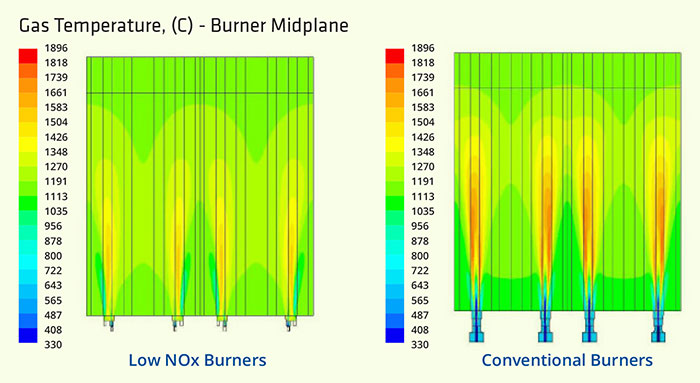
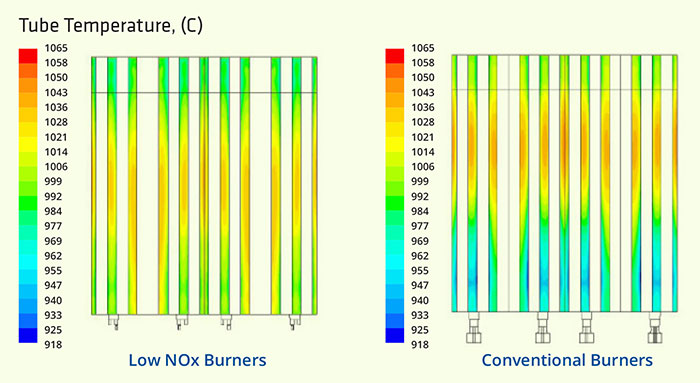
Computational fluid dynamics (CFD) modeling has been used to compare the thermal performance of low NOx and conventional burner designs in the MIDREX reformer environment (Figures 1-2). The results show that low NOx burners produce flame geometries similar to those of conventional burners and exhibit no increased tendency toward reformer tube impingement, an important reassurance for plant operators evaluating retrofit feasibility. The implications for heat transfer performance and efficiency are reflected in the operational benefits discussed later in this article.
Burner Control Systems
A burner control system (BCS)—sometimes called a burner management system (BMS)—is the control and safety architecture that governs burner startup, operation, and shutdown. It integrates three categories of hardware: field sensors and detectors (pressure switches, flow and temperature transmitters, and flame monitors); a processing unit, typically a Safety PLC; and safety interlocks and shutdown controls, including isolation valves in block-and-bleed arrangements (Figure 3).
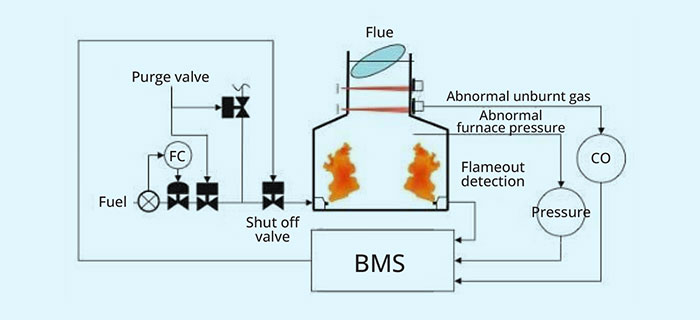
The purpose of a BCS is to prevent the formation of combustible atmospheres inside the reformer firebox that could result in a firebox explosion. Hazards managed by a BCS include improper purging, incorrect fuel-to-air ratios, excessive pressure or temperature, and gas leaks.
In a MIDREX Plant, the BCS manages two categories of burners: auxiliary (aux) burners, used during reformer heat-up and startup sequences, and main burners, which maintain normal operating temperatures. Aux burners present a more complex safety challenge because they must be lit individually, historically by hand torch, in a coordinated sequence.
The Standards Landscape
Three standards are relevant to MIDREX Plant operators evaluating BCS.
- NFPA 86:2023 is the U.S. standard for ovens and furnaces and defines baseline safety requirements for burner systems in North American applications.
- EN 746:2010 was the previous international standard for industrial thermoprocessing equipment. It has now been formally withdrawn.
- ISO 13577:2023 is the current international standard, covering industrial furnaces and associated processing equipment—specifically Part 2, combustion and fuel handling systems. Adopted in September 2024, it is not yet harmonized with regional regulatory frameworks but represents the direction for future international projects and new plant construction.
For existing plants, ISO 13577 compliance is not mandatory unless local regulations or insurers impose new requirements. However, the standard introduces a number of improvements in both safety and operational performance. Voluntary adoption merits serious consideration.
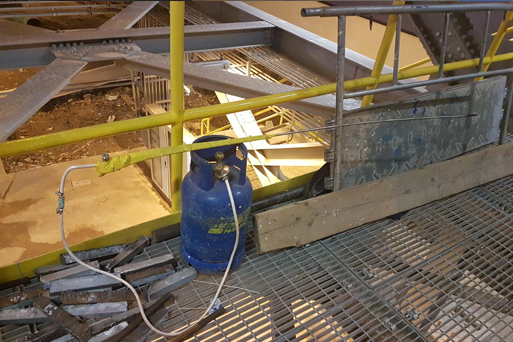
Most current Midrex Plants were originally designed to meet NFPA 86. The most significant change introduced by EN 746 / ISO 13577 is the requirement for automatic ignition and individual flame monitoring on all aux burners. Under previous practice, aux burners were lit manually with a torch—a labor-intensive, time-consuming, and inherently hazardous procedure performed at elevation in a high-temperature setting. Automatic spark ignition eliminates this need for personnel to physically light each burner, while continuous UV flame monitoring on every aux burner allows the control system to trip individual burners that extinguish rather than initiating a full reformer shutdown and re-purge sequence.
Although the capital cost of equipping a reformer with spark transformers, spark igniters, flame eyes, flame relays, and individual solenoid block valves is high, the increase in operating cost is small, and the operational benefits are significant. These include reduced purge occurrences, fewer refractory thermal cycles, faster plant startups, and improved visibility of burner status in the control system.
In addition, ISO 13577 imposes more rigorous standards for isolation valves, requiring automatic valves to comply with EN 161 and manual valves with EN 331. Previous practice using FM-approved valves is no longer sufficient. Related to this is the requirement for automatic valve proving systems: pressure switches integrated into the block-and-bleed train test for valve leakage before each startup, replacing the manual bubble tests previously performed during annual outages. This improves both safety and maintenance efficiency.
Additional changes address air/fuel ratio monitoring, with requirements for increased instrumentation and safeguards, and more rigorous documentation of maintenance activities.
Market Context And Incentives
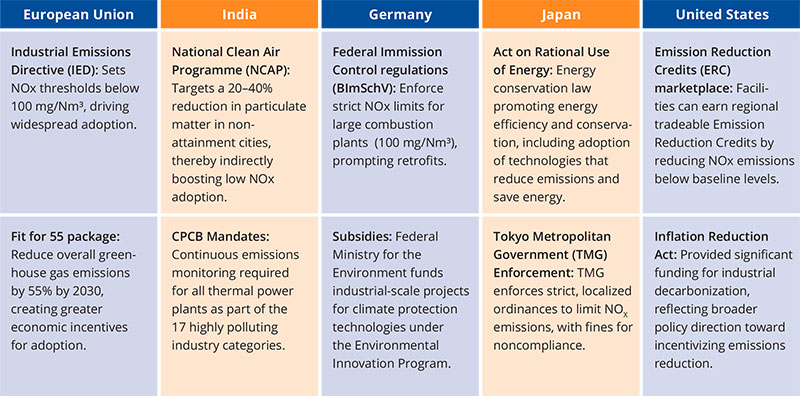
According to industry market research, the global market for low NOx burner technology is estimated at approximately USD 1.79 billion in 2026 and is projected to reach approximately USD 2.18 billion by 2033, driven by increasingly stringent emissions regulations and continued investment in cleaner, more efficient industrial combustion systems. The economic case for adoption is reinforced by a growing array of regulatory and financial incentives across key DRI markets (Table 1).
Beyond regulatory compliance, low NOx burners offer several operational and environmental advantages. Most directly, they reduce the NOx-related environmental and health impacts described above. Burners with more controlled, uniform combustion typically consume 5–10% less fuel than conventional designs, thereby reducing operating expenditure. More uniform combustion also delivers stable operation over a wide load range, with more even heat distribution across the reformer tubes, potentially extending service life.
By addressing NOx at the source, low NOx burners may also reduce the need for downstream abatement equipment. Finally, adoption supports compliance with tightening NOx limits across key markets and contributes to broader decarbonization commitments, increasingly a factor in how steelmakers are evaluated by regulators, insurers, investors, and other ESG stakeholders alike.
Retrofit Considerations For Existing Midrex Plants
Retrofitting low NOx burners and upgraded control systems to an existing MIDREX Plant requires attention to several plant-specific factors.
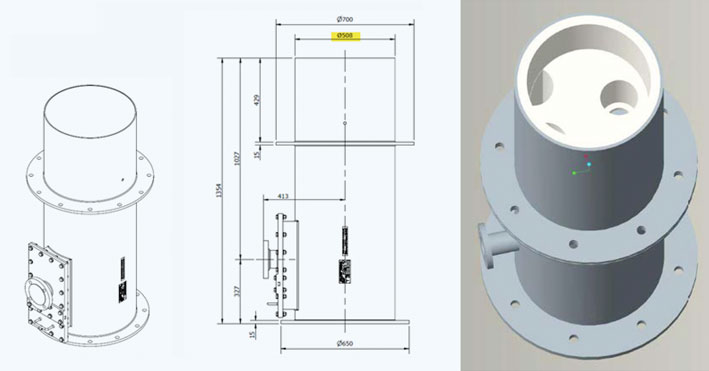
- Burner geometry compatibility is the starting constraint. Retrofit burners are typically required to be drop-in replacements that match the existing flange geometry, hose connections, and mounting arrangements of the original installation. Midrex Technologies has worked with Bloom Engineering to develop a low NOx Type A burner (Figure 5) that matches the dimensional envelope of the standard MIDREX Type A burner, enabling replacement without modification to the surrounding reformer structure.
- Main air blower capacity may require evaluation. Low NOx burners using staged-air combustion impose higher pressure drops across the air circuit than conventional burners. Depending on the margin available in the existing blower, an upgrade may be required.
- NOx suppression via air staging is a primary combustion-side lever. Controlling the introduction (sequence and proportion) of combustion air, rather than delivering it all at the burner throat, allows peak flame temperatures to be managed and NOx output to be reduced. This is a function of burner design rather than a separate system, but it interacts with the air-side hydraulics of the reformer and should be assessed as part of any retrofit study.
A structured retrofit evaluation thus encompasses a system process review to assess current plant performance and identify necessary process changes; equipment evaluations to determine retrofit capability and feasibility; and a control systems review covering existing BCS hardware and the instrumentation and processing upgrades required for ISO 13577 alignment. It also includes a capacity review to identify and address any debottlenecking requirements, as well as a financial review that incorporates CAPEX/OPEX projections, applicable emissions regulations, and available government incentives.
Conclusion
The combination of tightening emissions regulations, shifting international standards, and demonstrated operational benefits makes evaluating low NOx burners and modern BCS a timely consideration for MIDREX Plant operators. ISO 13577:2023 defines a higher baseline for combustion safety that, while not yet mandatory for existing plants in all jurisdictions, represents the direction of travel for regulatory and insurance requirements. The operational case, including improved fuel efficiency, greater combustion stability, safer and faster startups, and reduced maintenance burden, stands independently of the compliance question.
For MIDREX Plant operators, the technology now exists to retrofit low NOx burners that match existing reformer geometry while delivering measurably lower NOx output and more uniform heat distribution. MIDREX Technologies supports this transition, from process and equipment review through to control system design and economic analysis, ensuring that any upgrade is appropriately scoped and sequenced to deliver maximum value over the plant’s operating life.